

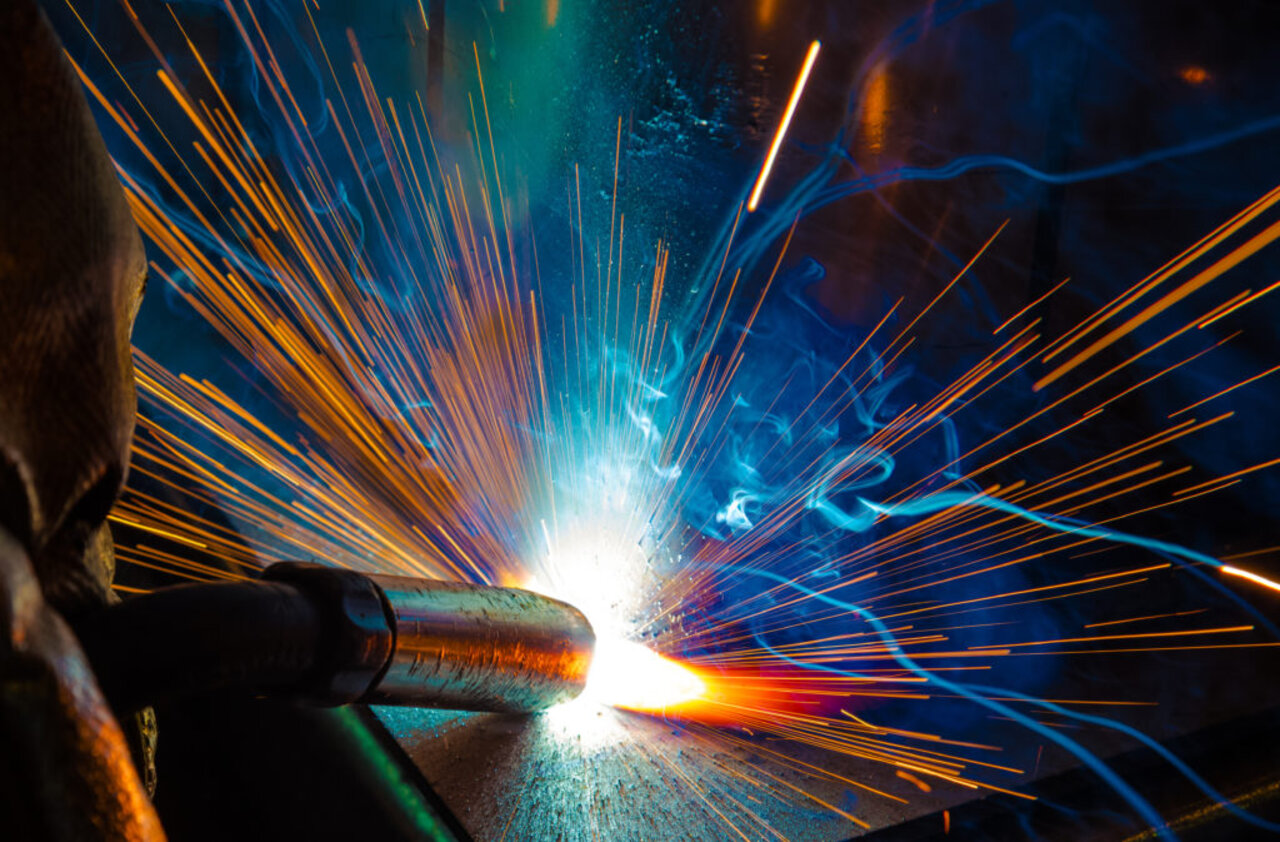
The future of welding isn't hiring more welders.
New handheld laser welding technology becomes a must. - Automation is no longer optional for welding shops.
The welder shortage is real.
Labor costs are rising.
Skilled welders are harder to find.
Existing welding processes are outdated and no longer economical.
Cycle times are under pressure.
Lasermach's handheld laser-welding machines combined with our robot/cobot laser-welding solutions are our answer — faster, compact, ecologically correct, energy saving, mobile, simple to program, much shorter production time, and built around our fiber laser technology.
PhotonWeld handheld fiber laser welders deliver super-fast superior TIG-quality results on steel, stainless, aluminum, and copper — and any operator can learn it in hours.
Robotic Laser Welding: Scope of Application
Our laser welding machines are equipped with a source power of max 3 kW, enabling perfect welding of steel, stainless steel and aluminium. The system is particularly suitable for welding thin-walled products with high aesthetic requirements, as very little post-processing is needed and heat input – and thus distortion – is kept to a minimum. Any soot formation that occurs during the process can easily be removed with a cloth.
Laser welding with Robot/Cobot fits seamlessly within our vision of welding automation. We remain true to our core: delivering high-quality laser welding solutions that really work in practice. Our European structure enables us to support companies of all sizes – from a single central European point of contact. Whether it concerns a first step towards automation or an advanced laser welding solution: Lasermach is ready as a partner who thinks along, develops and relieves you of all worries.

Laser welding: a safe and efficient step forward in welding automation
Laser welding is rapidly gaining ground within industrial welding technology.
What distinguishes our solution is, among other things, the flexibility to weld with or without filler material. In applications where filler material is required, Lasermach's Master R8-X Laser Welding Units offer a unique solution with its own wire feeding line. This wire feeding line with double drive has been specially developed for automatic robotic/cobotic processes and ensures perfect coordination between laser, robot and filler materials. As a result, even more complex weld seams can be carried out with high precision and repeatability.

Welding robots significantly help manufacturing companies reduce production costs and greatly improve working efficiency compared to manual welding.
▶First, welding robots run 24 hours a day non-stop without fatigue, breaks, or sick leave. Unlike human welders who can only work 8 hours per day and need rest shifts, robotic welding lines maintain stable output around the clock. For example, in automotive parts production, one welding robot can finish 300 chassis welding pieces per day, while a skilled manual welder can only complete about 120 pieces in the same time. The production efficiency is more than doubled.
▶Second, they cut labor and training costs drastically. Factories no longer need to hire and train a large number of professional welders, nor pay high salaries, insurance and welfare for manual workers. Meanwhile, welding robots keep consistent welding quality with almost no errors, spatter or rework. Manual welding often has defective products due to unstable operation, which wastes raw materials like welding wire, steel plates and gas. A machinery manufacturing factory can save 15%–20% of material waste cost every year after using welding robots.
▶Third, robotic welding lowers later maintenance and safety costs. It avoids work injuries, high-temperature occupational diseases and safety accidents caused by manual welding in harsh high-temperature and smoky environments. Fewer safety accidents mean lower compensation and management costs for enterprises.
In short, welding robots bring higher output, lower labor cost, less material waste and more stable quality, becoming an essential tool for modern factories to upgrade production.
Welding Automation Is No Longer Just About Cycle Time.
In high-mix, low-volume manufacturing, Changeover Time is becoming just as critical.
Every welding automation project involves three interconnected elements:
Fixture Design × Robot & Workpiece Setup × Welding Process & Path
Change one, and the others are affected.
For mass production, longer setup time can be absorbed by volume.
But in sheet-metal industry, the reality is different:
High Mix. Low Volume. Short Lead Time. Consistent Quality.
Customers may expect delivery within a week—or even faster.
Traditional industrial robot systems can require significant engineering effort every time a product changes: reprogramming, fixture adjustment, robot repositioning, and sometimes vision-system reconfiguration.
That’s where collaborative robotic welding makes a difference
Hand-guided teaching.
Fast path adjustment.
Quick changeover.
And most importantly—built around the welder’s experience.
The goal is not simply to make the robot weld faster.
Mass production competes on Cycle Time.
High-mix production competes on Changeover Time.
==>The future of welding automation is about one thing:
===>How fast can your automation adapt when the product changes?<==

Cobot or Robot: which one to choose?
You can consider following 5 factors to know which type of robot can help you the most in your application :
1. Industrial requirements :
As a plant manager, you have goals and KPIs to reach to make your business sustainable. Those should be the first things in your mind when making your buying decision.
The first requirement is about performance and cycle time.
On an equal footing, industrial robots provide unmatched technical specifications against collaborative robots. They are often faster, more accurate, powerful, and reach further. They thus better improve your cycle times and throughput rate. But collaborative robot models are providing higher and higher performance.
The second requirement is production volume and part variation.
Industrial robots are made to perform in high-volume manufacturing processes with low variations. They are not easy to reprogram and redeploy on new cell settings and part configurations.
Cobots, on the other hand, can flexibly adapt to part variations. You can set different programs for your different kinds of parts, and deliberately switch from one to the other. You can also place your cobot on a mobile platform to move it from one cell to another. So cobots are a perfect fit for high-mix, low-volume manufacturing processes.
Another requirement is the size, weight, and location of your parts.
Industrial robots are made to lift and handle heavy and large parts, which can be sometimes hard to reach. Meanwhile, collaborative robots thrive with low and medium part specifications and depend on their respective reach capabilities.
2. Type of application :
Industrial robots are still the best options when it comes to material removal and assembly applications, while collaborative robots show impressive results in finishing, machine tending, pick and place, and quality control applications.
Depending on your application, choose wisely which type performs the best.
3. Work settings
Do you have a huge manufacturing floor, or can you allocate only a small working cell to your robot? As they need fences for safety reasons, industrial robots can take up a lot of space. In contrast, collaborative robots safely work alongside your employees, so they can save you a lot of space and facilitate your worker’s movements.
4. Human resources
Do you have automation-expert engineers, or are you short of programming talents? That might greatly matter, as collaborative robots don’t need specific qualifications to code them, while industrial robots require more technical skills.
5. Automation goal :
What’s your main goal? Improving throughput, cycle time, turnaround time, freeing up workers from tedious tasks, improving their safety on the floor, maximizing output quality, or minimizing waste…?
All-in-all, collaborative robots can improve your worker experience while providing greater performance and quality. Industrial robots exclusively aim at augmenting your speed and quantity of output. Your final decision will depend on what you want to improve on your manufacturing line.
You now have everything in your hands to make a mindful decision. Cobot or robot, it’s all up to you!
