

Laser Welding of Pillow Plates
Laser Welding of PillowPlate or dimpled jacket plates
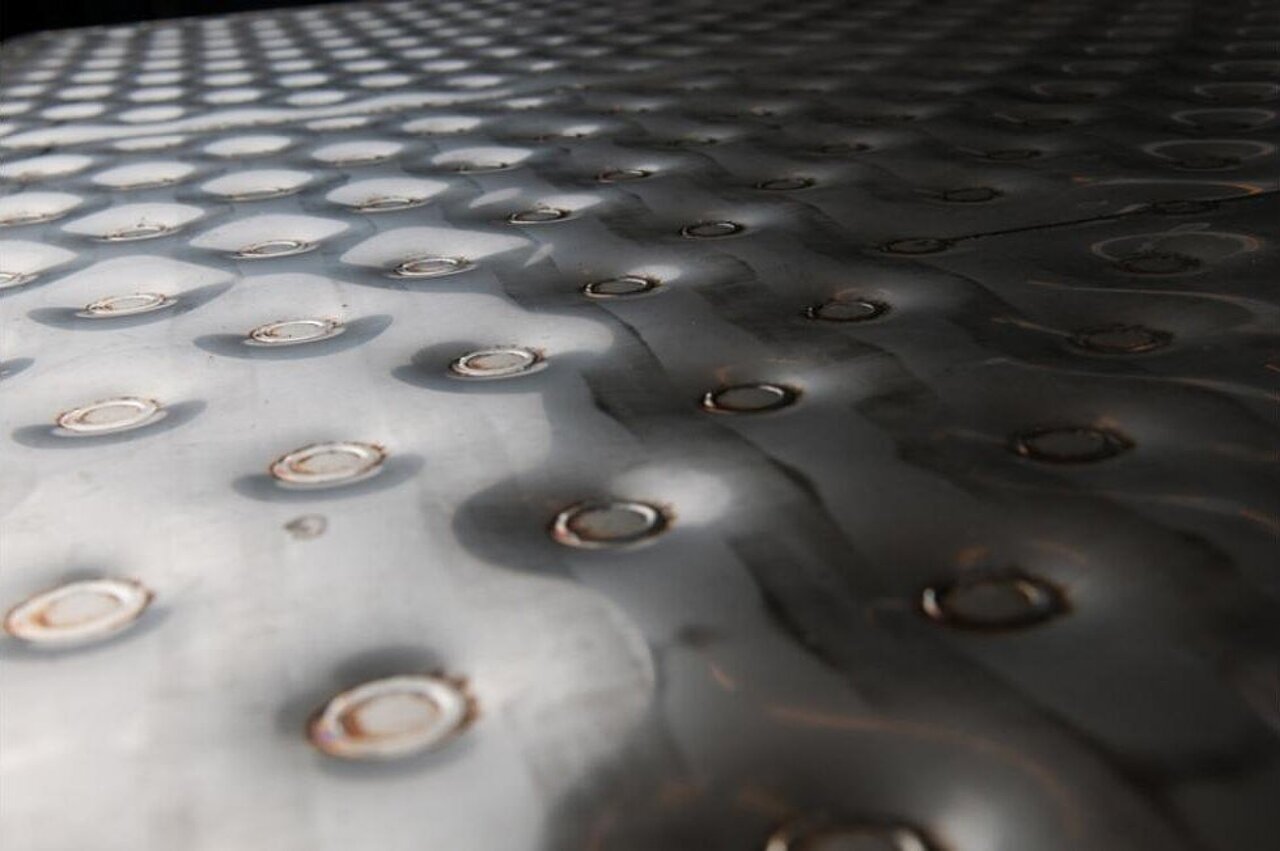
What is a Pillow Plate? - What is a Dimple jacket plate?
What’s the pillow plate heat exchanger?
Pillow Plate heat transfer surface is a panel-type heat exchanger that can be made in an endless range of shapes and sizes. It is ideally suited for applications involving high pressures and temperature extremes.
A Pillow Plate or dimple jacket plate consists of two stainless steel sheets that are laser welded together by welding a custom circle weld pattern. The outside perimeter of the Pillow Plate is fully laser welded to create a pressure boundary. At the edges of the Pillow Plate, a contour is welded to create a pressure-tight part.
The Pillow Plate is hydraulically inflated by using water through a hydrostatic pump. Hydraulically inflating will guarantee for a safe inflation process. Other inflation processes can be used depending on the application.
The inflation process pressurizes the two sheets which allows the material to deform, a cavity will be created for use of a heat transfer medium. The laser welded Pillow- or dimple jacket Plate can be used with either liquids, steam, gasses or refrigerants
Pillow plate Heat Exchanger provides the highly efficient heat transfer performance. By the fiber laser-welded and inflated channels induce fluid great turbulence to attain high heat transfer coefficients.

PillowPlate or dimpled jacket plates
Laser welded cooling plates
The Photonweld wobble cube is able to produce PillowPlates which can be used for a large range of products, such as; heat exchangers, filter housings, falling film, square containers, cooled containers, offen walls, climate chambers, ice accumulators, pipes, heated or cooled vibration feeders and in cylindrical tanks, as well as in tanks of other shapes and designs, for example rectangular or oval ones. They can also be used for various industries for example food and beverage industries and other food-making and process industries. The surface can be brushed, polished or sandblasted. Possibilities are endless because you can produce every weld pattern shape and any required plate shape can be welded or engraved. The PillowPlates can be single or double embossed plates.

Design (single of double embossed Pillow plates
A Pillow Plate design is always custom-made. At first there must be looked at the desired application.
Do you need a plate with pillows on one side and a smooth surface on the other (for example, applications for cooling milk tanks or heat or cool applications in food or the pharmaceutical industry), then choose a single embossed Pillow Plate. The flat product side of the single embossed heat exchanger are used for sanitary product applications. Due to the precise laser welding process applied, we can guarantee that no heat tint will occur after welding, the material is welded with the protective PVC foil in place.
Double embossed Pillow Plates are plates that exists of two sheets with similar material thicknesses. This product will deform on both sides after inflation as no flat side is required for the application. The double embossed product is used for immersion applications, clamp-on applications, other process equipment like heat recover banks and refrigeration applications.

Single embossed plates
Single embossed plates are used for application where a thicker plate holds a product and transfers heat or cooling to the object through the thicker plate.
Applications include rolls, flat plates, walls, and bottoms of tanks, as well as various types of thermal equipment.
Tanks: Tank with pillow plate.
- Tanks general
- Wine and beer tanks
- Milk and cheese tanks, bulk milk coolers (BMC)
- Fermenting tanks
- Chocolate tanks
Others:
Flat cooling plates under transport belts (chocolate lines)
- Trough for olive oil or ironing textile
- Rectangular basins
- Cooled containers
- Climate chambers
- Hoppers
- Food cookers
- Clamp on plates (add a heat exchanger to an existing tank wall)
- Pipes
- Vibration feeders
- Freeze dry plates, ammonia at -40°C

Double embossed plates
Double embossed plates are two inflated plates with the same thickness and holding one medium in the plate and the other medium around the plate.
It is therefore possible to use the outside or inside of the plate for the medium/product to be cooled or heated.
Examples:
- Steam or hot water inside – product outside. The goal is to heat the product on the outside of the plate.
- Example: Water inside – river water outside. The goal is to cool the process water inside the plate.
The majority of the plates used in these applications are immersed in liquid and are referred to as immersion plates.
However, it is also possible to recover heat from gases or exhaust air by condensation of the latent heat or to cool or heat solid granulates, bulk solids, with the plates, such as sugar or fertilizers (NPK, CAN). The continuous production of ice water at 0.5°C using a falling film water chiller and the creation of an ice buffer using an ice bank are two major industries. These are applied in foodindustry where constant or instant cooling is needed.
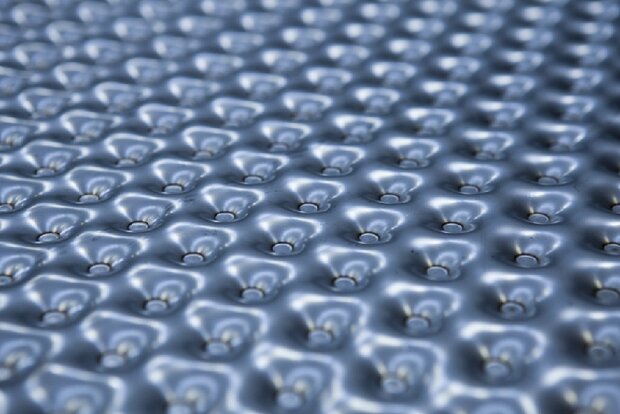
Laser Welding of Pillow plates
Low cost automatic Production of pillow plates
Pillow Plates, also called dimpled plates or thermo plates, consists of two stainless steel sheets that are laser welded together by welding a custom circle weld pattern. Then the plate is inflated by using water pressure, which creates a specific single or double embossed profile – the pillow plate, through which the cooling or heating is conducted. The thickness and the spot pattern are determined by the pressure requirements.

Pillowplate laser welding
The maximum product size depends on the width of the laser welding machine.
Pillowplates can be designed with thin top plates for the applicable working pressure. For instance with 1.0 mm plate we can reach a burst pressure of 180 bar. With 2.5 mm we can design heat exchanger plates with burst pressures of 400 – 500 bars. Generally 98% of the pillowplate material is stainless steel, 304L up to 254SMO.
The working pressure global guideline:
Water / glycol / thermal oil: 1 – 5 bar
Refrigerant Freon – NH3: 19 bar (at 20oC)
CO2 refrigerant: 120 bar
Steam: 0.5 – < 30 bar
Pillowplate specials
Pillowplate pipes diameter 100+ mm
Copper and titanium pillowplates
Satellite simulation plates
Cryogenic plates

Advantages of laser welded Pillow Plates
- Cost-effective due to low welding costs
- Thinner materials can be used, saving you on material costs
- Pillow Plates' welding pattern guarantees high turbulence and therefore creates higherr overall heat transfer coefficients
- Reduced deposition (algae, lime, etc.) due to this higher turbulence (less fouling) and higher pressure possible
- Due to the low volume in the plate, little cooling / heating fluid needs to be circulated. As a result, less pump capacity is required
- By working with laser welding machines that are CNC-programmed, all desired shapes, recesses, fastening points and connections are possible
Dimple Plates vs Pillow Plates
The term Dimple Plate is also often used for Pillow Plates. Originally, Dimple Plates are preformed sheets that are attached to the final product afterwards, while Pillow Plates are already being processed in the application. The use is largely the same, but in production time and usage possibilities, there are big differences.
Before Pillow Plates were produced with laser welding machines, pre-formed Dimple Plates were an alternative. With the arrival of laser welding machines the advantages and possibilities with Pillow Plates have grown enormously.
Difference in design
Both are mostly produced from stainless steel sheets. In the case of pre-formed dimple plates, dimples with a small hole are punched into the plate. After the plate has been rolled into the desired shape, the plate is welded to the end product. For example, existing tanks that have to be converted into a cooling tank.
Pillow Plates, on the other hand, are two plates that are welded together by a laser welding machine. After the plates are rolled in the right shape, the plate is only inflated and the Pillow Plate is evenly attached to the surface. This offers many advantages over preformed Dimple Plates:
- Welding with a machine is faster, so you save time
- The laser welding machines are more accurate than manual work.
Application
The biggest difference between preformed Dimple Plate and Pillow Plate is in the application.
Preformed Dimple Plates are suitable for small surfaces and mountend to the existing tank. In addition, pre-formed Dimple Plates can handle a maximum pressure of 4/5 bar, while Pillow Plates can be used at much higher pressures.
For segments where high pressure plays a major role, such as in the chemical or pharmaceutical industry, Pillow Plates are the best quality solution.
What is the best pillow height for your pillow plates?
Most of our new customers either manufacturing vessels, food processing machines or any custom requirement, they mostly have the same question:
“What is the best pillow height?”
This is an important question because generally customers tend to have some habits or thumb rules when it comes to the pillow height. Do aim to create turbulent flow with your welding pattern so you can create the same or higher heat transfer but using less amount of refrigerant or heating medium in the plate.
After inflating your pillow plate you should generally reach pillow heights between 2,5mm to 3mm. But there are some cases when you are able to get special pillow heights depending on the material, material thickness or welding pattern which is related with the working pressure required.
Let us hear about your requirement for pillow plates and we will be creating a laser welded solution for you by answering any questions you have in mind.