

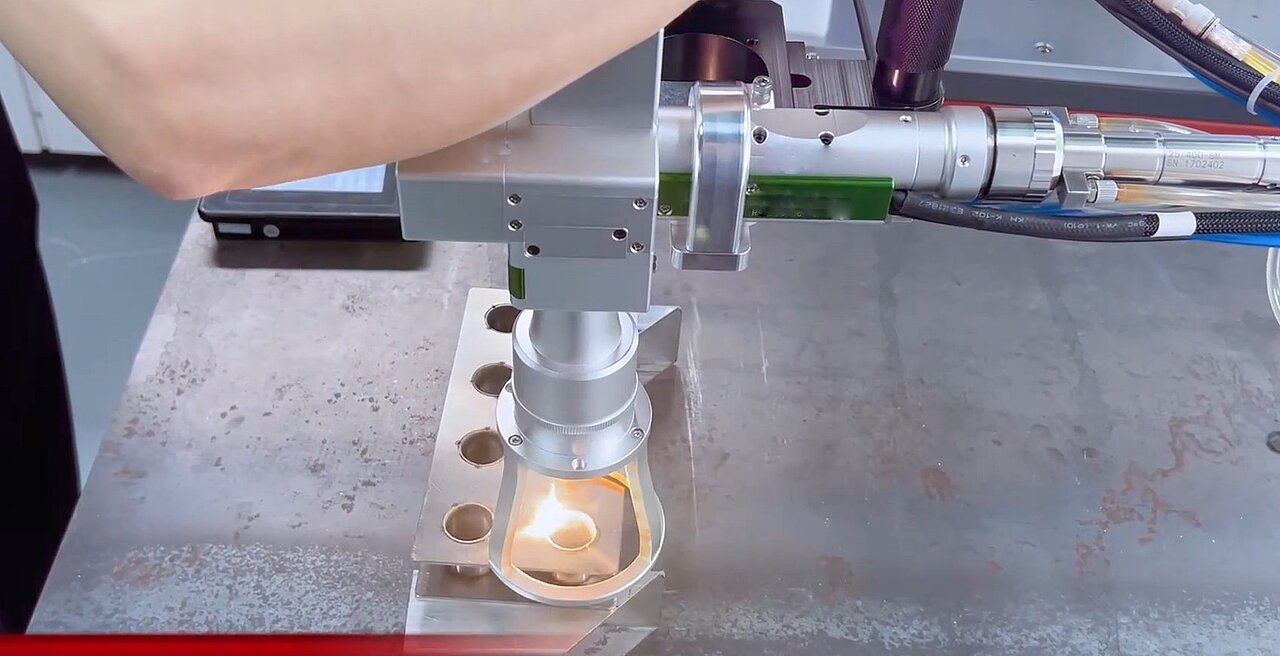
Explore the key aspects of both Laser Spot Welding and Laser Seam Welding.
Laser welding technology is a powerful tool in modern manufacturing. It offers precision and efficiency unmatched by traditional welding methods.
Among the various techniques, Laser Spot Welding and Laser Seam Welding stand out.
Understanding these methods is crucial for industries that rely on high-quality, precise welds.

What is Laser Spot Welding?
Laser Spot Welding is a process where a laser creates a weld at a specific point. This method is ideal for joining small parts or components with high precision.
Laser spot welding is a precise welding method that uses slow pulse beams to bond a material to a specific area. This technique is commonly applied to materials that don’t require full adhesion but instead involve specific part welding.
Applications:
- Electronics: Spot welding is commonly used to join delicate components without damaging them.
- Jewelry: It allows for precise welding of tiny, intricate pieces.
- Automotive: Spot welding is used in assembling various car parts, especially in battery production.
Advantages:
- High Precision: Laser Spot Welding provides accurate welds with minimal distortion.
- Minimal Heat-Affected Zone (HAZ): The laser focuses on a small area, reducing the risk of warping.
- Speed: The process is fast, making it suitable for mass production.
Limitations:
- Limited to Small Areas: Spot welding is best for localized welding and may not be ideal for larger joints.
- Equipment Cost: The equipment can be expensive, making it a significant investment.
Laser Spot Welding is an excellent choice for applications requiring precision and minimal heat impact. Yet, its limitations must be considered when selecting the best welding method for your project.
Benefits of Laser Spot Welding
Energy Efficient
Laser spot welding is energy efficient because it bonds materials in less time and energy than seam welding. Instead of welding an entire component, spot welding is specific to one area and doesn’t need to be applied all over.
Localised Welding
Laser spot welding only focuses the laser on one area of a component, yet still successfully welds together. The localised welding aspect means that laser spot welding is achievable on sensitive components and doesn’t disrupt electricity or other functions.
Fewer Cracks
Laser spot welding is less susceptible to cracking from the weld. Since the weld doesn’t adhere as tightly as a seam weld, the material has room to breathe and doesn’t crack under pressure.

What is Laser Seam Welding?
Laser Seam Welding is a continuous welding process that joins two materials along a seam. This technique is ideal for applications requiring long, uninterrupted welds.
Laser seam welding incorporates the spot welding technique, but instead of targeting one area, the spots are welded along a continuous seam. This technique uses a laser with a continuous or rapid pulse beam. Since laser seam welding covers a larger area, it provides more strength and coverage.
Applications:
- Automotive Industry: Seam welding is used in producing fuel tanks, exhaust systems, and other components requiring airtight or watertight seals.
- Aerospace Industry: It ensures strong, continuous welds in critical structures.
- Metal Fabrication: Seam welding is used in manufacturing pipes, tubes, and other cylindrical structures.
Advantages:
- Continuous Welds: Seam welding produces long, consistent welds, ideal for applications needing a strong seal.
- High Speed: The process is efficient, allowing for quick production of welded seams.
- Reduced Post-Weld Processing: Seam welding often eliminates the need for more finishing processes.
Limitations:
- Complex Setup: The equipment setup for seam welding can be more complex compared to spot welding.
- High Equipment Costs: Like spot welding, the initial investment can be significant.
- Limited to Linear Joints: Seam welding is best suited for straight or gently curved seams and may not be ideal for complex geometries.
Laser Seam Welding is highly effective for creating long, durable welds, particularly in industries where strength and consistency are critical.
Benefits of Laser Seam Welding
Ultimate Strength
Laser seam welding is welding across a seam—instead of one spot—so there’s a more substantial adhesion between materials. The adhesion strength withstands harsh conditions and pressure, which makes it ideal for applications needing to prevent leakages. The strength also means that seam welding is used in industries with tight regulations and risks, like automotive, aerospace, and medical devices.
No Heat Stress
One would think that the more a beam is used, the more heat stress. But that is not the case. Laser seam welding does not apply any more heat stress than spot welding does.
Even though laser beams technically use heat, laser seam welding heat transfer is significantly less than traditional welding methods. Laser seam welding successfully sticks materials together without damage even though the beam moves across a large area.
Precise and Clean Lines
Precision is a constant in laser processing, and seam welding is no different. Laser seam welding maintains precision along seams without deviating.
Lightweight
Using laser seam welding helps manufacture lightweight aircraft and automobiles. Instead of using heavy steel nuts and bolts, using seam welding gives the same security without the extra weight.
PhotonWeld Special laser Seam&Spot-Welding Machines
O-PRO Series: Our Special Orbital Laser Welding Machines
Orbital laser welding Machines, point laser welding machines, circular seam laser welding machines, spot laser welding Machines

lntelligent dual swing handheld energy storage welding torch
With single or dual wire feeder optional
Circle Welding: Max Diameter 20mm
Square welding : Max dimension 20 x 5 mm

Laser Spot welding Machines
Dual swing handheld energy storage welding torch

orbital laser Welding Machines - Circular laser seal welding Machines
Intelligent pipe welding head - circular and square pipes

Laser Stud Welding Machines

Applications for Laser seam- & Spot Welding Techniques
Laser spot welding and laser seam welding work together in industries like automotive and EV batteries, but they each shine on their own in the oil & gas and semiconductor industries. When deciding between laser welding techniques, consider the sensitivit
Oil & Gas
The oil & gas industry uses plant piping that stores water, sewage, gas, and powders. These pipes are pressurised and face harsh environmental changes like severe weather, rust, and vibration. But, if these pipes burst, human and environmental health is at stake.
Because of the severity of leakage, laser seam welding is a reliable method for sealing pipes to prevent leaks.
Semiconductor/Electronics
Semiconductors are made up of tiny components, each serving an electrical function to ensure the semiconductor works correctly. Some semiconductors have dozens of layers. With all the layers, the components must be welded one at a time and without contamination.
Since each component must be placed per spot, laser spot welding is ideal. Laser spot welding allows for each component to be placed without affecting anything else around it or threatening the integrity of the semiconductor.
Automotive
The automotive industry benefits from spot and seam laser welding techniques.
Laser seam welding succeeds at tight and long welds that assemble vehicle frames. The seam follows the frame’s outline and bonds the thick metal components together. The strength of laser seam welding is also used for sealing gunpowder for airbags. When an airbag goes off, the weld keeps the gunpowder in while inflating the airbag.
The automotive industry also uses spot welding for smaller welding needs. Laser spot welding works well for adding adhesion to nuts and bolts.
EV Batteries
Laser seam welding is used for stacking electrodes to make prismatic and pouch batteries. The tight weld between electrodes creates a strong bond between layers, so energy flows smoothly. Once the electrodes are stacked to form a battery, laser spot welding is used to bond the batteries inside the battery pack and make specific connection points.