

ABR Anti-Back-Reflection Technology
The ABR technology provides the product with super anti-reflection ability.
The ABR technology with independent property rights provides the product with super anti-reflection ability, adopts multiple anti-high reflection structure design, effectively increases the reliability and life of the laser, and is suitable for processing highly reflective material, such as stainless steel, copper, brass, aluminum, and gold and silver, etc.
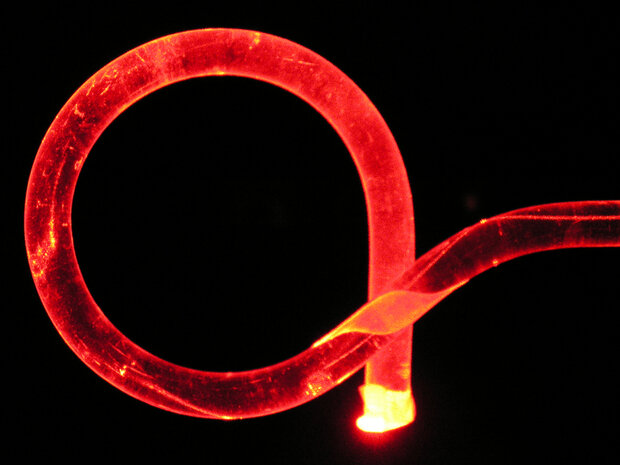
Our ABR(Anti-Back-Reflection) unit is a proprietary technology independently developed by us specific for welding applications of high-reflection materials like copper, aluminium, etc.
The used CPS (Cladding Power Stripper) device used in the PhotonWeld-Pro optical module can effectively absorb the reflected light thru the cladding layer
while removing the residual pump light from the cladding layer to further protect the gain cavity of our laser source.
The cladding power stripper (CPS) is directly cooled by the heatpump cooling system.

Cladding Power Stripper: A Critical Component for High-Power Fiber Laser Systems
As fiber laser technology continues to advance, the demand for higher power output, greater efficiency, and improved system reliability has increased significantly. High-power fiber lasers are widely used in industrial manufacturing, telecommunications, scientific research, and medical applications. To ensure optimal performance and long-term stability, these systems rely on several specialized optical components, one of the most important being the Cladding Power Stripper.
A Cladding Power Stripper is designed to remove unwanted optical power propagating within the cladding of a fiber while preserving the signal carried in the fiber core. By efficiently dissipating excess cladding light, it helps protect downstream components, improve system efficiency, and maintain stable laser operation.
Understanding Cladding Light in Fiber Lasers
In high-power fiber laser systems, pump light is typically coupled into the cladding of a double-clad fiber. While most of the pump energy is absorbed and converted into useful laser output, a portion of the light can remain trapped in the cladding. This residual cladding light can create several challenges if not properly managed.
Excess cladding power may generate unwanted heat, interfere with signal quality, and potentially damage sensitive optical components. As laser power levels continue to increase, effective cladding light removal becomes increasingly important for maintaining system performance and reliability.
This is where the cladding power stripper plays a crucial role!

How a Cladding Power Stripper Works?
A cladding power stripper is specifically engineered to remove residual light traveling within the fiber cladding. It achieves this by introducing controlled attenuation mechanisms that extract unwanted optical power while allowing the core signal to pass through with minimal loss. The unwanted light in the cladding of the fiber leads to poor beam quality and incorrect measurements.
A reliable Cladding Power Stripper is an important component for modern high-power optical applications. By removing unwanted cladding light, it helps manage thermal loads, protect downstream optical components, and support stable system performance.
The ABR technology with independent property rights provides the product with super anti-reflection ability, adopts multiple anti-high reflection structure design, effectively increases the reliability and life of the laser, and is suitable for processing highly reflective material, such as stainless steel, copper, brass, aluminum, and gold and silver, etc.
A cladding power stripper is a mode stripping device designed to remove any light that travels in the cladding and helps ensure that the laser beam results are based only on the effects of the core and not the cladding.
The stripped optical energy is then safely dissipated as heat through an optimized thermal management structure. This process ensures that only the desired signal remains within the fiber core, improving overall system efficiency and protecting downstream optical devices.
Once you are able to properly manage the unwanted light, you can significantly improve the quality of the system and the output light beam as well. The unwanted light generates across the chain of components forming a system, and each of these components has a specific task to perform.
Because the core signal remains unaffected, cladding power strippers provide highly efficient operation without compromising laser performance.
Key Benefits of Using a Cladding Power Stripper:
Improved System Reliability
Removing unwanted cladding light reduces the risk of overheating and optical damage. This helps extend the lifespan of laser components and improves overall system stability.
Enhanced Thermal Management
Residual cladding power can generate significant heat within a laser system. Cladding power strippers efficiently dissipate this energy, reducing thermal stress on surrounding components.
Better Optical Performance
By eliminating unwanted light, the device helps maintain beam quality and signal integrity. This contributes to more consistent laser output and improved application results.
Protection of Sensitive Components
High-power optical systems often contain components that can be damaged by excess optical energy. A cladding power stripper helps prevent unwanted power from reaching these sensitive devices.
Support for High-Power Operation
Modern fiber lasers continue to push power limits higher. Cladding power strippers are specifically designed to support high-power environments while maintaining stable operation.
