

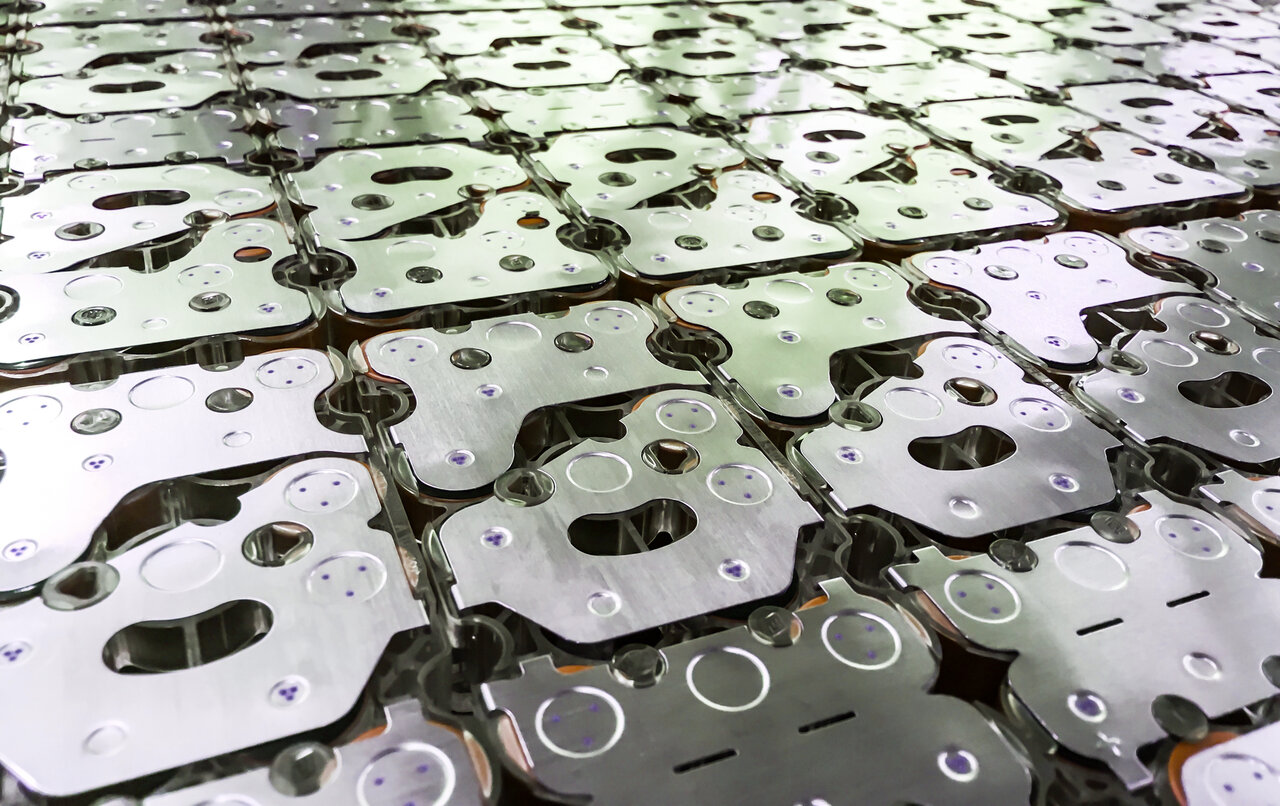
The challenges of e-mobility: Welding busbars
With the development of e-mobility, the task of welding busbars – connectors allowing electricity flow between various components – has become essential for battery manufacturers.
The surge in e-mobility manufacturing has led to an increased demand for electric batteries and, consequently, for busbars. To enable the electrical current to flow through the battery, busbars must be securely welded to the battery cells. Therefore, one of the biggest challenges is optimizing the welding of these components, a task made complex by the specific properties of the metals involved.
Laser welding is the most effective technique for the automotive EV industry. This method produces high-volume, high-quality welds and is particularly well-suited for welding copper and aluminum. These materials are preferred for their stable electrical conductivity over time, even during the strong vibrations typically experienced in a car.
- Copper: Welding copper is challenging due to its high reflectivity at 1 µm – the wavelength of conventional infrared lasers. This means that only about 5% of the laser energy is absorbed at room temperature, making it difficult to initiate the welding process. However, once welding starts, energy absorption increases during the liquid phase. Copper’s high thermal conductivity makes welding unstable, leading to potential defects such as:
- Porosity, which can diminish electrical conductivity.
- Spatter, which can cause short circuits.
- Cracks, which can adversely affect mechanical performance.
- Aluminum: Welding aluminum is also challenging due to its ductility, which can lead to deformation during the welding process. Like copper, aluminum’s high thermal conductivity also makes welding unstable. Certain alloys, such as the Aluminum 6xxx series, are more complex to weld than others.
Due to the high cost of copper, minimizing defective parts is essential. Achieving optimal electrical conductivity and durability in copper welds requires them to be free from pores and spatter, which can only be done through laser beam shaping. Aluminum’s ductility also poses a challenge for achieving high-speed, high-quality welds without beam shaping. Additionally, different EV components require specific welding configurations, including varying weld sizes, depths, and arrangements.

Laser welding is the preferred high-speed, automated method for joining battery busbars to cell terminals in electric vehicle (EV) manufacturing, providing high electrical conductivity and structural strength.
It creates precise, low-heat joints (usually copper or aluminum) with minimal deformation, significantly reducing weld times compared to traditional methods.
Key Advantages of Laser Busbar Welding
- High Speed & Efficiency: Capable of making thousands of connections with, in some cases, welding times under 100ms per cell, significantly increasing throughput compared to ultrasonic methods.
- Low Thermal Input: Minimizes the heat-affected zone (HAZ), crucial for preventing damage to sensitive battery cell components.
- High Precision: Delivers excellent repeatability for complex busbar designs with micron-level accuracy, reducing failure points.
- Minimal Spatter & High Quality: Dual-beam technology and fiber lasers virtually eliminate spatters and porosity, ensuring high-quality, reliable bonds.
Key Applications and Techniques
- Materials: Primarily used for copper and aluminum busbars, often connecting them to nickel-plated steel cell cases.
- Wobble Welding: Laser beam wobbling is often used to effectively stir the weld pool, ensuring consistent penetration and managing brittle phase formation (like in steel joints).
- Automation: Integrated seamlessly into automated, robotic manufacturing lines for mass production.
Challenges and Considerations
- Material Reflectivity: Copper and Aluminum have high reflectivity, requiring high-power fiber lasers and optimized techniques to ensure proper fusion.
- Narrow Process Window: A very precise laser power is needed to avoid over-penetration or damage to the cell interior, particularly with thin materials.

Battery Welding: Using Lasers for Battery Tab Welding Applications
From a welding perspective, the most important aspects of tab welding are the thickness and material of both the tab and the terminal.
Conductivity is the name of the game, so battery tabs are generally made of aluminum or copper, sometimes plated with nickel or tin. Terminals may be cold rolled steel, aluminum, or copper, depending upon the physical size of the finished battery.
The most common battery types are cylindrical lithium ion cells around the 18650 size (18 mm x 65 mm), large prismatic cells, and lithium polymer pouch cells. Each cell type has a different set of welding requirements.
Cylindrical batteries
The key to welding the cylindrical cell type lies in the negative terminal weld, where the battery tab is welded directly to the can as opposed to the separate platform on the positive side. The weld on the negative terminal must not penetrate the can thickness which is typically around 0.015-inch (0.3mm). The thickness of the can dictates how thick the tab can be – a rule of thumb is that the tab should be 50-60 % that of the can. Cylindrical battery can material is usually nickel-plated steel, and the tab material nickel or tin-coated copper. Nickel plating is preferred over tin because it is more stable; tin’s very low boiling point can lead to weld porosity and excessive spatter.
Large prismatic batteries
These high capacity cells need thick tabs to ensure a sufficient current carrying cross-section to deliver the pack output. However, the tab connection needs only to deal with the capacity of a single cell. Therefore, thinning or “coining” of the thick tab material to enable a lap weld or creating a through hole for a fillet weld greatly reduces the size of the weld needed. This in turn reduces heat input to the can, which is always a concern when welding thicker tabs.
For a lap weld geometry, reducing the tab thickness to a 0,2 - 0,4 mm thickness enables sufficient weld area for strength and capacity while keeping the temperature during the weld low enough to avoid battery damage. Material selection is generally aluminum for both terminal and tab – recommended tab materials are 1080 and 1100. Avoid aluminum alloy 6061, which cracks when welded. If this material is already specified and cannot be changed, use a 4047 pre-form as a third material which will introduce a large amount of silicon into the weld, which prevents weld cracking.
Lithium polymer batteries
These pouch type cells, which are thin with a rectangular footprint, are really gaining traction for consumer electronics. The terminals on these batteries are made up of thin layers of copper and aluminum foil which are laser welded to tab of copper and aluminum respectively. This weld is traditionally made using ultrasonic technology due to the need to weld through a stack of foil, however, fiber laser welders are now being used for increased weld quality and strength. The key to success in this application with a fiber laser is making sure that (a) the foils are in close contact and (b) you’re using a pulsed laser to avoid overheating.
Battery and bussbar laser welding machines

Manual bussbar and battry welding machine
till maximum 65mm diameter
