

Laser deburring creates smooth, rounded edges that prevent cuts to operators as well as to cable and cause also surface damage.
Laser deburring can the edges strengthenen, the fatigue strength of the components can be increased and the tendency to crack reduced.
After metal sheet cutting and stamping, burrs generated on the edges increase the risk of injury to personnel and may also damage or scratch objects in contact with them. For this reason alone, it makes sense to deburr such edges.
If this is done using a laser, not only can the edges be strengthened in a targeted manner, but the fatigue strength of the components can also be increased and the tendency to crack reduced.
Deburring by handlaser
A long list of benefits
The potential of this technology is far from exhausted. Deburring sheet metal in particular is uncomplicated, improves component quality, and thanks to processing speeds of up to fifteen meters per minute, is also fast and efficient.
Deburring is necessary to minimize the risk of injury. Additionally, sharp burrs on cut and punched edges can often damage cables and scratch surfaces. Until now, mechanical processes have usually been used to remove burrs. However, it's clear that laser processes for deburring have clear advantages here. The process itself is uncomplicated. The laser focus must hit the front of the edge and cover it completely. There, the focused beam of light briefly melts the metal edge and burr. The surface tension then causes the liquid metal to smooth itself out. To improve this, Lasermach has increased the power of the laser, which provides additional energy input that melts more material, placed around the edge like a reinforcing round seam.
The smooth, rounded edges prevent cuts as well as damage to cables and surfaces. But the laser process can do more: It leaves defect-free edges. This resulted in a clear advantage in the fatigue strength and mechanical forming behavior of the sheet metal components. Tests with high-strength steel show that its fatigue strength increases by 200 percent as a result of laser deburring. At the same time, the degree of deformation resistance increased by 185 percent. Until then, the edge crack can be avoided. Laser melting eliminates any micro-defects in the edges caused by mechanical processing. Such pre-damage, which is invisible to the naked eye, is often where crack formation begins.
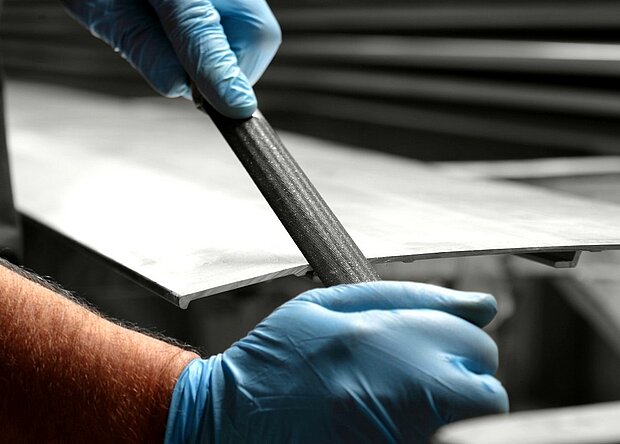
Laser deburring is fast, clean and inexpensive
Another major advantage of laser deburring over mechanical processes is that no grinding dust is produced. Instead of removing it, the process only briefly melts the excess material into the sharp corner, this makes the part stronger and reduces a enoying and unhealthy task of grinding
It is comparatively easy to integrate laser deburring into existing process chains and production environments. Where integration is practicable, the benefits quickly become apparent: "Laser deburring is particularly advisable for highly stressed components!. Chassis parts as an example could be a perfect sample of it. The increased fatigue strength in the edge area allows their manufacturers to design them to be thinner and therefore lighter and ultimately more fuel-efficient. Even with formed 3D sheet metal components, the laser can be mounted on robots.
The standard lasers in the near-infrared wavelength range became also inexpensive and readily available.