

Handheld Laser Welder Cooling Systems Explained and compared
Air Cooling vs Water Cooling vs Dual-Circuit Refrigerant Direct Cooling
In any handheld laser welding machine, the cooling system plays a decisive role in maintaining consistent performance and welding quality.
As laser power increases and working environments become more demanding, temperature management directly impacts stability, efficiency, and equipment lifespan.
Today, the three most common cooling methods are:
air cooling,
water cooling, and
the advanced dual-circuit refrigerant direct cooling system.
Let’s explore how they differ and which laser welding machine fits modern industrial needs best.
1. Air Cooling: Simple Design, Limited by Ambient Temperature
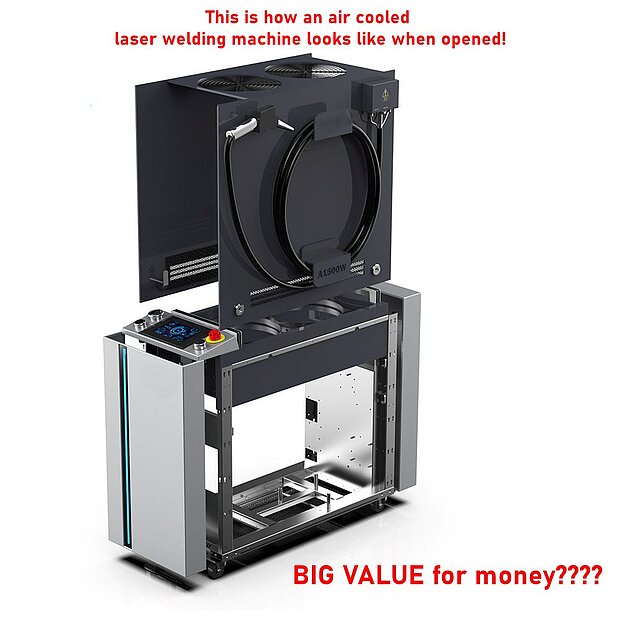
Air cooling for a laser welding machine is the most basic and cheapest type of heat dissipation system. It uses fans to circulate air taken from outside the machine, through the device, removing heat from internal components.
Its structure is compact and cost-effective, but performance is highly dependent on environmental conditions.
Key Features:
- Advantages: Low cost, simple design, no coolant required.
- Disadvantages: Limited cooling capacity; performance drops sharply in hot or cold environments.
- Working Range: Typically operates within 25°C–30°C
- Runtime: Continuous operation may lead to overheating, stopping, power loss or startup failure.
- Continuous operation will lead to high internal temperature with result of super fast aging of the machine
Best For:
Short-term, light-duty welding tasks where temperature fluctuation is minimal. Not suitable for long run welds, lower thermal endurance.
2. Water Cooling: Reliable but Maintenance-Heavy
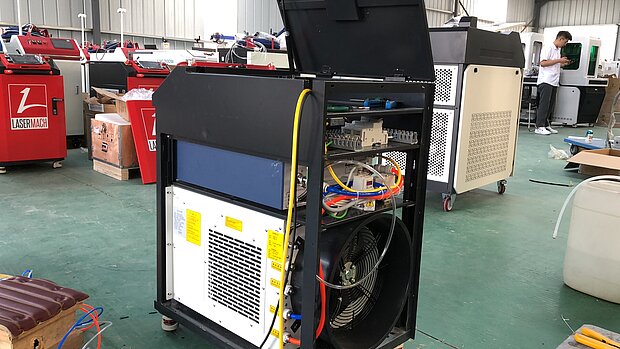
Higher energy consumption and difficult to move due to heavy weight
Water cooling remains the most widely used cooling method in today’s laser welding machines as it is relative efficient cooling and relative cheap!
It uses circulating coolant to transfer heat from the laser source to a condenser or chiller unit.
Key Features:
- Advantages:
- Efficient heat dissipation with steady temperature control.
- Long term welding is better than air cooled ones
- Relatively cheap
- Disadvantages:
- Operating temperature range limited to 5°C–50°C;
- Requires periodic coolant replacement and antifreeze additives in winter;
- Risk of scaling, clogging, or leakage over time.
- Heavy weight and very big volume
- Not mobile at all!
- Much higher energy consumption
- Maintenance:
- Regular cleaning and monitoring are essential to ensure consistent cooling performance.
- Winter change with anti freeze
- Waterpump maintenance
- Cleaning of internal scaling deposit
Best For:
Workshops and factories operating in stable room-temperature environments and stay on a fixed position to weld

3. Dual-Circuit Refrigerant Direct Cooling: Intelligent and Energy-Efficient
Heat-pump cooling is the lowest cost in energy consumption for the optimal cooling
The principle of compressor refrigeration (heatpump) is to compress the refrigerant into a high-temperature, high-pressure gas, which then flows to the external condenser. The gas condenses into a low-temperature, high-pressure liquid, and the heat generated is discharged to the outside through a fan. The low-temperature, high-pressure liquid refrigerant is decompressed by the expansion valve and becomes a low-temperature, low-pressure steam, which flows to the internal evaporator. The evaporator absorbs heat, lowers the temperature inside the laser, and the refrigerant evaporates into a high-temperature, low-pressure gas. The gas is then compressed again, and the cycle is repeated for continuous refrigeration.
Our dual-circuit refrigerant direct cooling system represents a major breakthrough in handheld laser welder temperature control.
By using two independent circulation loops — one for the laser core (pump source and optics) and another for intelligent system temperature balancing — it achieves real-time thermal precision and maintenance-free stability.
It delivers a much more stable and energy-efficient laser welding solution?
As laser welding continues moving toward higher power and greater precision, traditional air- and water-cooling methods are reaching their limits.
Dual-circuit refrigerant direct cooling (heatpump) stands out as the next-generation solution—offering intelligent temperature control, superior efficiency, and reliable performance in any environment.
This system ensures that handheld laser welders maintain optimal output stability under 24/7 industrial workloads, marking a new standard for precision welding technology.
Laser Welding System Cooling Comparison Overview
Feature | Air Cooling | Water Cooling | Dual-Circuit Refrigerant Cooling |
Cooling Method | Air convection | Liquid circulation | Direct refrigerant heat transfer |
Temperature Range | 18–35 °C | 5–50 °C | -30 °C to 60 °C (constant) |
Temperature Control | Passive | Semi-stable | Intelligent & Precise |
Energy Efficiency | Average | Moderate | Up to 50% higher |
Maintenance | Low | High (coolant change) | None (sealed loop) |
Welding Stability | Limited | Moderate | Superior – <1% Power Fluctuation |
Suitable For | Light tasks | General industry | High-precision, long-duty welding - high Production enviroment |
A water-cooled laser welder uses a traditional liquid chiller loop (pump, reservoir, and water/antifreeze circulation) to absorb and dissipate heat,
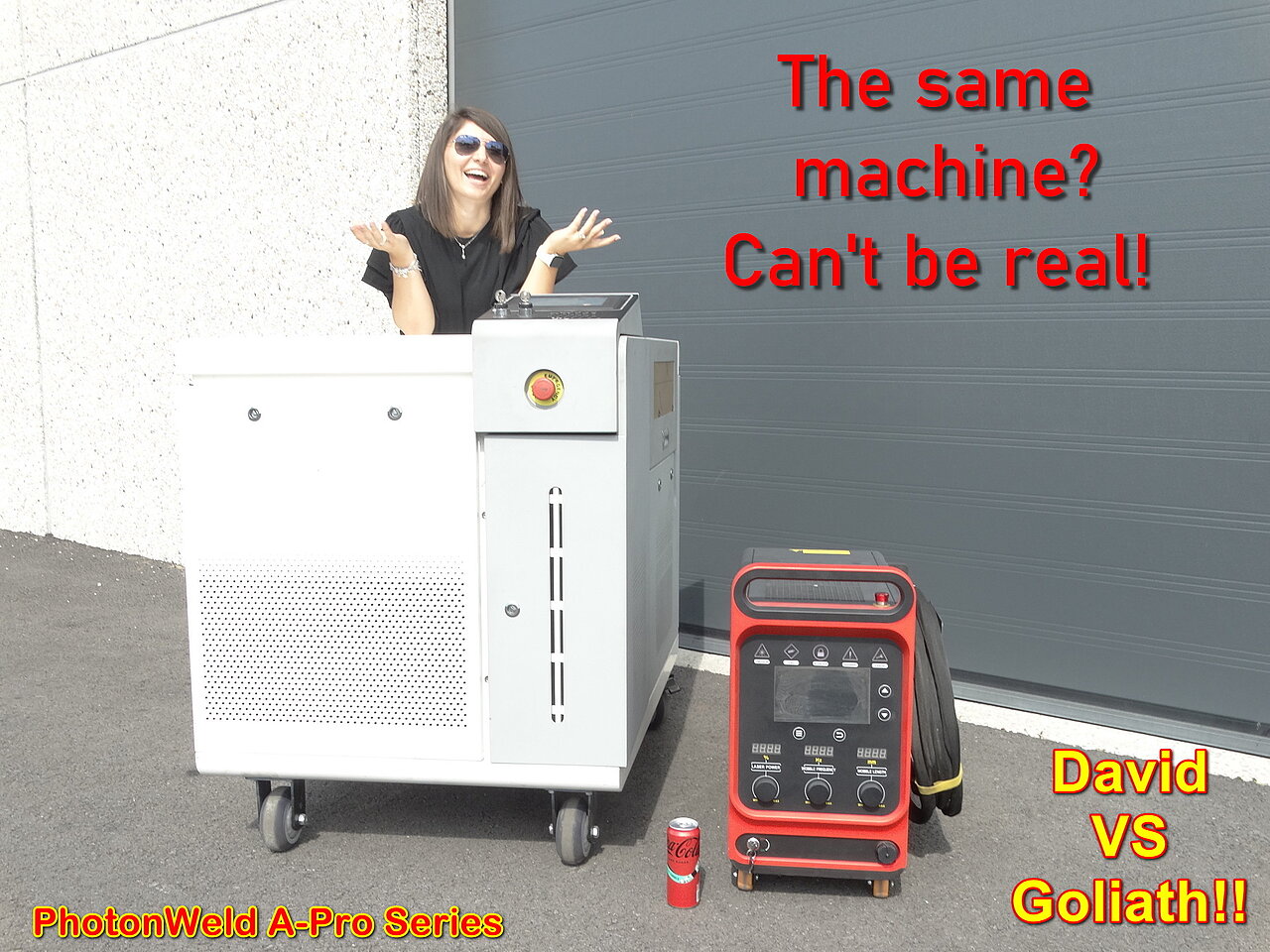
whereas a heat-pump-cooled laser welder (such as modern units by PhotonWeld)
uses a compact, active refrigerant heat-pump / dual-circuit compression cycle to manage thermal loads.
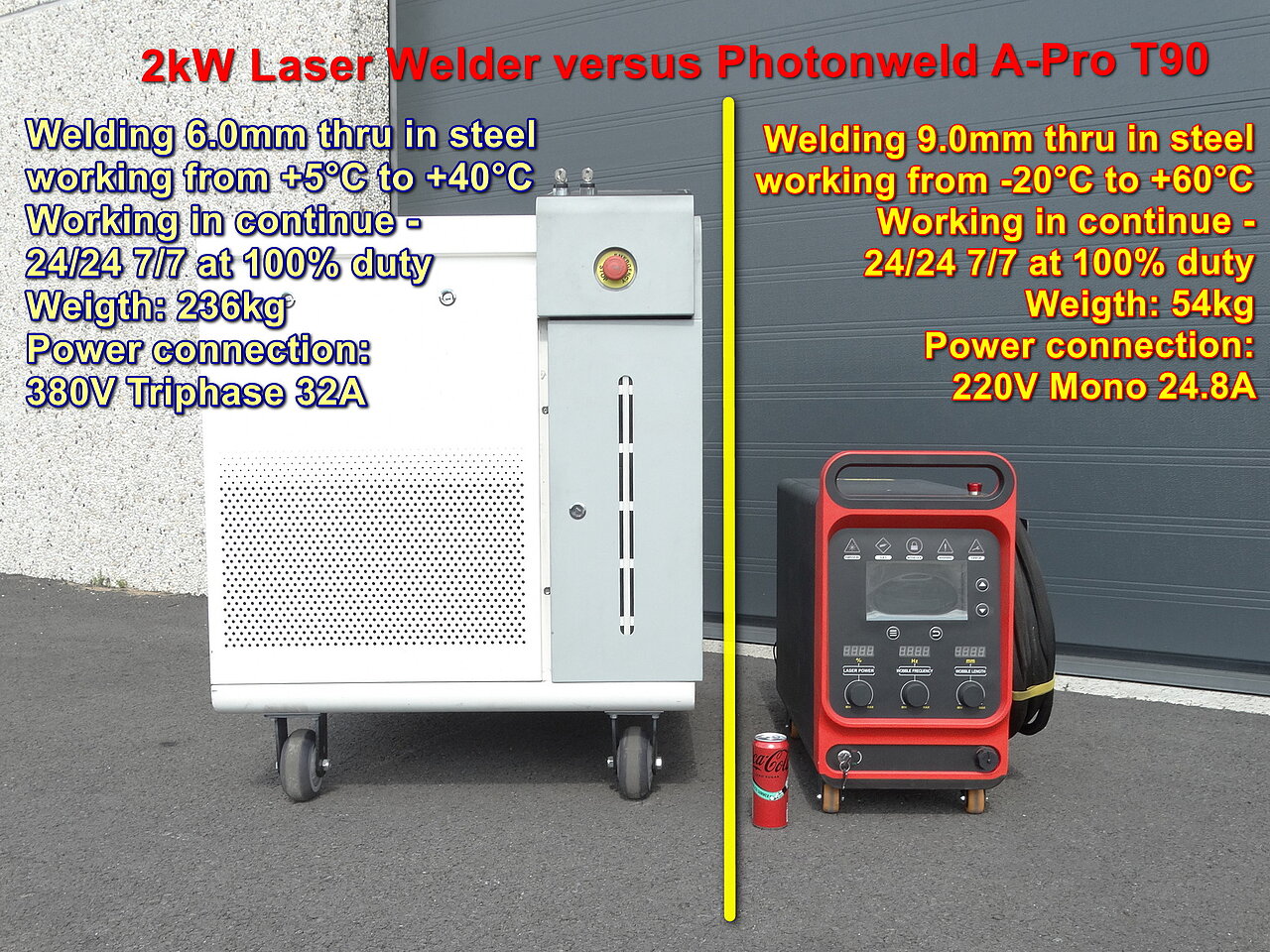
Water cooled laser welding machine versus Heat pump cooled laser welding machine (PhotonWeld)
Key Differences
Feature | Water-Cooled Laser Welder | Heat-Pump-Cooled Laser Welder |
|---|---|---|
Cooling Mechanism | Circulates liquid water/coolant through a heat exchanger or separate chiller unit. | Uses an integrated heat-pump / refrigerant cycle (often dual-circuit) inside or attached to the unit. |
Duty Cycle | High (often supports continuous or heavy industrial shifts, depending on chiller size). | 100% duty cycle capability across extreme ambient temperatures (typically -20°C to 60°C). |
Size & Weight | Generally bulkier and heavier due to external/integrated water tanks and chillers. | Significantly more compact and lighter (often fraction of the size/weight of traditional water chillers). |
Power Consumption | Typically draws higher overall electrical power for pumps and compressor chillers. | Engineered for lower energy consumption (e.g., up to 50% less power than standard setups in some portable builds). |
Maintenance & Risk | Requires regular coolant changes, anti-freeze monitoring, leak checks, and scale/algae management. | Sealed/semi-sealed refrigerant loop; eliminates traditional water-line freeze risks, algae buildup, and frequent fluid top-offs. |
The detailed air cooling technology difference
When we talked about the air cooling laser welding sources. There is still have the difference between different technology. Although they are all called air-cooled lasers, the air-cooling schemes used are different: fan cooling, heat pipe cooling, compressor cooling.
Fan cooling uses a substrate (heat-sink) with good thermal conductivity (such as copper or aluminum etc.) to transfer the heat generated in the pump source and gain cavity to the heat sink, and then dissipate the heat by convection. Convective heat transfer can be divided into natural convection and forced convection according to the driving force of air flow.
Heat pipe heat dissipation relies on the phase change of the working liquid inside the heat pipe to transfer heat. This liquid has a low boiling point and is easy to evaporate. One end of the heat pipe (evaporation end) is connected to the laser's radiator, and the other end (condensation end) is connected to the external radiator and fan. The tube wall contains a wick made of porous material. When the laser generates heat, the evaporation end heats up, causing the working liquid to evaporate rapidly. The steam flows to the condensation end under the action of the pressure difference, releases heat through the fan, and condenses into liquid again. The liquid returns to the evaporation end through the wick (in a gravity heat pipe, the liquid adheres to the tube wall and flows back under the action of gravity). This cycle continues to transfer the heat inside the laser to the outside.
Key Differences: Air-Cooled Laser Welders vs. PhotonWeld
Feature | Standard Air-Cooled Laser Welders | PhotonWeld (by Lasermach) |
|---|---|---|
Cooling Technology | Standard internal fans/heatsinks or basic dual-circuit air-gas systems. | Patented dual-circuit heat pump cooling system. |
Operating Environment / Duty Cycle | Typically suited for standard workshop temperatures and intermittent-to-steady use. Higher than 800W is fast overheated!
| Rated for 24/7 non-stop operation at 100% duty cycle in extreme temperatures (-30°C to +60°C). Till 3000Watt standard |
Positioning | Ranging from lightweight/portable models (e.g., 1200W–2000W) to general fabrication. | Heavy-duty industrial grade; designed to replace or bridge TIG/MIG with high-speed production focus. |
Maintenance & Extras | Varies widely by brand; generally lower maintenance than water-cooled, no external chiller needed. | Engineered for low-maintenance, multi-function use (welding, cleaning, cutting) with integrated eco-efficiency ("EcolEner"). |
Core Comparison Breakdown
1. Cooling and Reliability
Standard Air-Cooled: Eliminates the bulky external water chiller of traditional laser systems, making the machine lighter and easier to move around the shop or site. However, cheaper air-cooled units can face thermal throttling or duty-cycle limitations if pushed hard in hot summer factory environments.
PhotonWeld: Uses a specialized heat pump cooling architecture rather than standard ambient-air fins alone. The manufacturer rates it to operate continuously around the clock (24/7) in harsh ambient temperatures ranging from -30°C to 60°C, which bridges the reliability gap usually reserved for heavy water-cooled systems.
2. Performance and Application Scale
Standard Air-Cooled Machines: Best suited for light-to-medium fabrication, repair work, thin-to-moderate sheet metal (typically handling up to maximum 3–4 mm, and mobile or light on-site jobs where portability matters more than continuous industrial hammering.
PhotonWeld: Marketed specifically as an industrial-grade "Pro-Series" platform meant for high daily volumes, continuous production lines, and integration into robotic/cobot stations alongside standalone manual use.
3. Common Similarities
No External Water Chiller: Both share the primary perk of air cooling—no water lines, no risk of freezing coolant, and lower overall setup complexity compared to legacy water-cooled fiber lasers.
Which Should You Choose?
Water cooled laser welder versus heatpump cooled laser
Choose a Water-Cooled Welder if:
You are running a fixed, heavy-duty industrial shop floor, require ultra-high laser power configurations (3kW to 6kW+), and already have dedicated utility support for a stationary industrial water-chiller setup.
Choose a Heat-Pump-Cooled Welder if:
You want the high thermal stability and 100% duty cycle of liquid-level cooling without the heavy weight, water-leak risks, freezing hazards, or high maintenance of a traditional water tank/chiller—especially for mobile, semi-portable, or energy-conscious fabrication environments