

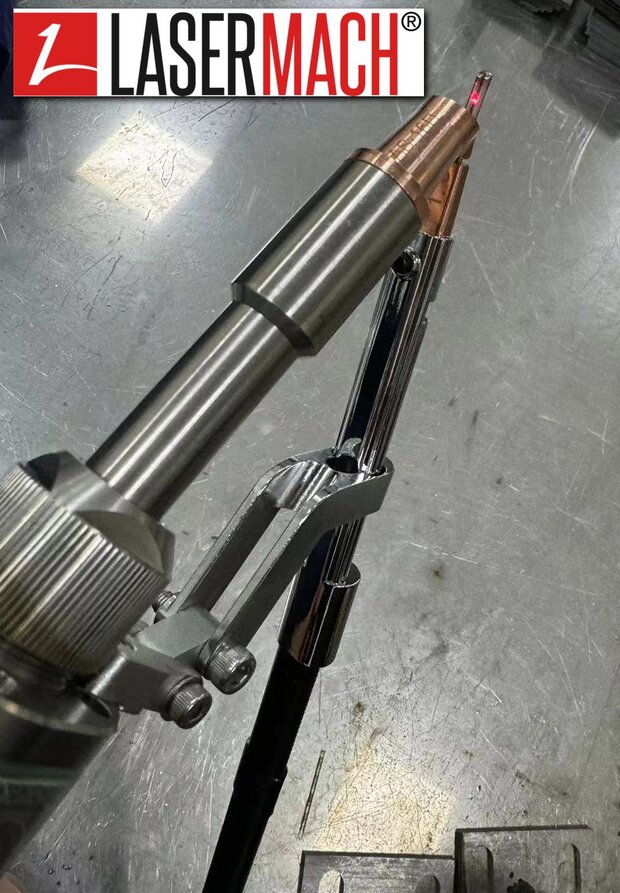
Laser Welding Projects take care for an Optimal Wire Feeding
Lasermach offers single wire, double wire and soon triple wire laser welding solutions
Wire feeding is an essential measure to address any metallurgical flaw in the welded joint, especially when working with dissimilar metals.
With the correct welding wire and feeding technique, wire feeding can significantly improve your laser weld’s strength and longevity.
Equipped with physical control buttons for easy manual operation, wire feeding becomes an easy task with a PhotonWeld laser welding machine.
Lasermach offers single wire, double wire and soon triple wire laser welding solutions with high-accuracy automatic full electronic wire feeders.
Our wire feeders have enhanced wire capacity that supports wire feeding up to 2 mm.
Some manufacturers skip wire feeding when using laser welding.
But this step can actually make a huge difference to their product quality and production process.
Advantages of a good laser welding wire feeding system
Enhanced Weld Quality: A welded joint will have uniform metallurgical strength and integrity when the metal wire is augmented as filler material directly into the welding seam. This eliminates all potential impurities in the fused workpieces, such as gaps, cracks, or distortion.
Increased Versatility: Fusing dissimilar materials often results in joint gaps and cracks upon solidification. For this reason, many operators refuse to weld dissimilar metals. With wire feeding, metallurgical gaps formed by dissimilar metals can be addressed, which improves an operator’s versatility and flexibility.
Higher Deposition Rates: Wire feeding results in improved material deposition rates, which helps in faster welding of thicker sections of the workpieces.
Reduced Thermal Distortion: The filler wire can serve as additional “padding” that helps in distributing the beam’s heat more evenly. This results in a smaller heat-affected zone (HAZ) and minimized thermal distortion.
Cost Efficiency: As wire feeding addresses most resulting flaws of a laser welding process, the need for post-welding clean-up declines. This saves the manufacturer’s time and resources in the long run.
Best Practices for Optimal Wire Feeding at laser welding
Choose an appropriate welding wire: The ideal wire must be compatible with the workpieces and the laser welding machine to be used. Commonly used wires include stainless steel, titanium, and aluminum.
Clean or Polish the weld area: Prior to the positioning of the welding wire, make sure to clean the weld area to avoid contamination of the wire. Any contaminants that might touch the wire can compromise its quality. Clean especially good at the start point.
Pick a consistent wire feed speed: An automatic feeder with a rate of 1 to 5 meters per minute is the standard. Make sure to adjust the feed rate according to the thickness of the metals. The feeder’s accuracy must be spot on as well, even a 5% deviation from the wire feed speed set value can adversely affect the weld quality.
Observe careful wire positioning: It is important to lead the wire directly into the target spot with minimal deviation (<0.5 mm) because the laser applies the beam in a highly precise way