


The Heart Of The Laser: The Semiconductor Laser Chip (pumping diodes)
The most important part of the handheld laser welding machine is the fiber laser!
The most important part of the handheld laser welding machine is the fiber laser source; regardless of the heat dissipation method, it is necessary to ensure effective heat dissipation of the fiber laser source. The core of heat dissipation in the fiber laser is the semiconductor laser chip(s) (pumping diodes) in the laser source, which can be considered to be the heart of the laser. If the laser chip can not get effective heat dissipation, the risk during long-term use is that power attenuation increases and the life expectancy of the laser source will be drastically reduced. This affects the service life of the handheld laser welding machine, which is an extremely critical component. In the current state of technological development, the working life of the laser chip will decrease rapidly with the temperature; the chip's own normal operating temperature needs to be maintained under 75 ℃, and the recommended maximum safety working temperature should be below 60 ℃.
Why is the working temperature of your laser welder so important?
For every increase of temperature of +10 °C above optimal working temperature, electronics lifespan are cut in half.
Thermal management helps control the temperature within the sealed enclosure of the laser source, to prevent electronic components from overheating. Although individual manufacturer's specifications vary, most electrical distribution and control equipment operates longer and more effectively under ambient air conditions ranging from 32° - 38°C. Temperatures that exceed this range can and will damage electronics, causing outages or permanent failure. In fact, every ten-degree rise in temperature, shortens the average reliability of electronic equipment by 50%, so it's important to have a reliable enclosure cooling system in place to protect heat-sensitive components.
How does temperature affect the reliability of electronic components?
What is the temperature threshold for electronics to start breaking down?
For every +10 C change electronics lifespan are cut in half.
And for every -10 C change electronics lifespan are doubled.
That is a rather truthful fact.
To have an idea of this temperature influence, is to get a starting number on the expected lifespan.
We take here the prescibed life expectancy of the electronic condensators used in a laser source as sample:
Some components are easy like electrolytic capacitors. They have it printed on them:
A consumer grade capacitor that is marked 85 °C have only 1000 hour expected lifespan at 85 °C temperature.
2.000 h at 75 °C,
4.000 h at 65 °C,
8.000 at 55 °C,
16.000 h at 45 °C
32.000 h at 35 °C and
64.000 h at 25 °C (room temperature).
So that explains why it is important to keep the temperature low on electronics.
If that capacitor is changed to a higher standard of a 105 °C variant instead it would last 4 times longer as the 85 °C capacitor would.
But it is about 2,3 times the cost of the 85 °C capacitor.
Any elctronic device is negatively influenced by higher temperature!
The price of a laser welder at aquisition is not representing the real value per hour working!
When a machine like PhotonWeld resist 80.000~100.000 hours and the other cheaper air-cooled one resist only 12000 hours or even much less,
even if the buying price of the second is half the price of the first, your welds are 6 to 7 times more costly per welded meter if you buy the cheaper air-cooled version!
Similarly aspects (Voltage, current, power, temperature and mechanical) stress factors also exists.
An electronic designer may design to 90% of these parameter and your device may last to the end of the warranty +1 day in 24/7 operation…
Or it is designed to be below 50% of all those parameters and it will last about 20 years with normal usage (<8 h per day).
But this better quality components will increases the Bill Of Material cost with at least 85%, but more likely 145 to 208%.
Nothing is theoretical designed to fail. But usage profile and expected lifespan is for sure an important design decision.
Upper management and top sales personnel have mostly a bad influence on this decisions…!!!

Graph added:comparison of thge lasersource and the pumping diodes of our photonWeld -Pro Series and one Major laserwelding machine supplier with only pure air cooling
component temperature at different ambient temperature in our photonWeld Pro Series and in one of the major other laser welder suppliers with only air cooled machines
Laser housing temperature
RED: Photonweld-Pro serie = ultra stable laser source housing temperature : 36°C +- 2°c
BLEU: Major air cooled laser welding machine supplier = reach the 69°, which is 9°C above the safety temperature and 25°C above the recommended working temperature= damaging of the pumping diodes!
Laser Chips (pumping diode) temperature
Purple: PhotonWeld Laser chips (pumping diodes) ultra stable temperature : 67°C +- 3°C
Green: Major air cooled laser welding machine supplier laser chips temperature: 104.0° C and higher = almost 40 °C above safe working temperature = Damaging and drastic reduction of the lifetime of the source
Horizontal: ambient temperature
Vertical: inside temperature of housing and laser chips
Temperature control ability is the key to keep beam-stability and penetration consistency under prolonged thermal stress
The “10°C increase = half life” rule is based on applying the Arrhenius equation, which relates the rate of chemical reactions, R, to temperature, to failure mechanisms that occur in electronics.
In applying the Arrhenius equation to electronics, it is assumed that the rate of chemical reaction corresponds to the damage to devices over time
and the equation can then be used to compare the damage accumulated over time for different operating temperatures.
Conclusion: Lifetime of our machine is guaranteed around 80~100.000 hours, while the air cooled more economical version from one of the major suppliers has a 16 to 32 times shorter lifetime, due to higher working temperature!
Who is here finally cheaper?
What is the best buy?

Dual-Circuit Refrigerant Direct Cooling: Intelligent and Energy-Efficient
The dual-circuit refrigerant direct cooling system represents a major breakthrough in handheld laser welder temperature control.
By using two independent circulation loops — one for the laser core (pump source and optics) and another for intelligent system temperature balancing — it achieves real-time thermal precision and maintenance-free stability.
The Xtron laser refrigerant handheld welding machine equipped with a dual-circuit refrigerant constant temperature intelligent system avoids the problem of poor adaptability to air-cooling and water-cooling environments. It combines the advantages of both and achieves breakthroughs, bringing good news to welding in more regions and different scenarios.
The dual-circuit refrigerant constant temperature intelligent system combines intelligent preheating and intelligent cooling. It starts automatically when the handheld welding machine is turned on. It can automatically identify the external ambient temperature and make intelligent adjustments to provide the best working temperature for the equipment, thereby achieving a super environment . Adaptable , can work stably in -30℃~60℃, 90% high humidity environment.
Dual-circuit refrigerant constant temperature intelligent system, naturally fearless of severe cold
It is the first to use a new environmentally friendly refrigerant as the refrigeration medium. It has extremely high stability and a freezing point as low as -155°C . It fundamentally solves the risk of freezing of the cooling medium in winter. There is no need to repeatedly replace the cooling medium, and there is no need to increase the cost of additional coolant. Eliminates the risk of damage to equipment and components due to blockage of cooling water lines.
This PhotonWeld constant temperature intelligent system has directly addressed the pain points of handheld welding environment adaptability from the beginning of its development and design, and is naturally not afraid of severe cold.
Dual-circuit refrigerant constant temperature intelligent system, worry-free low temperature startup
For handheld welding, the temperature control system is the most important system for adjusting the working environment of lasers and other components. It comprehensively improves energy utilization efficiency through cooling, heating and internal heat conduction. The complex internal structure of handheld welding makes it ineffective to change the ambient temperature through manual operation, so its own "temperature control system" will play the most vital role.
Lasermach's dual-circuit refrigerant constant temperature intelligent system will automatically heat in low-temperature environments, protect the pump source and other core components, and ensure that the welding machine can operate stably for a long time even at ultra-low temperatures of -20°C.

LASERMACH:
Lasermach Dual-loop refrigerant direct cooling laser welding machine:
OurPhotonWeld Series can maintain continious stable performance in very harsh environments. Tested by international laboratories, it can continuously output light between -30 and 60 degrees Celsius, as well as up to 90% relative humidity. It utilizes Lasermach's's patented technology—the Intelligent Double Circuit Circulating Constant Temperature System. We have a complete dual circuit refrigerant circulation pipeline. The entire pipeline is in close contact with the pump source and other main heat-generating components, removing heat directly from the source. Numerous temperature sensors monitor the pump source temperature in real time. If the chip temperature rises slightly, the system automatically increases the compressor's cooling capacity; if the temperature is too low, it automatically reduces power consumption. Temperature control accuracy is stable at ±0.3℃, unaffected by ambient workshop temperatures, even at 50-60℃. The laser's core components maintain their optimal operating temperature to ensure stable output power. Automatic sensing and precise temperature control enable effortless continuous welding. The high-performance condensation cooling device, with an ultra-large fin area and efficient cooling material, continuously dissipates heat, supporting long-lasting high-performance light output. The self-developed high-converting light source brings lower heat generation and a continuous high-energy beam. Using an efficient compressor and intelligent refrigerant control, the core components cool automatically to the perfection, unaffected by external temperature changes, and keep the source and components temperature at a stable working temperature, optimal for the lifetime extension of the machine.
In summary, only our PhotonWeld Pro-Series with our selfdevelopped heatpump dual-loop refrigerant direct-cooling laser welding system employs an intelligent design, utilizing a temperature monitoring system and a refrigerant system to regulate the temperature with a high precision of all core heat-generating components. This ensures stable power output and weld quality even under full load operation, without any reduction in power. Only effective thermal management prevents beam drift and ensures uniform weld during continuous, high-power industrial runs.


Temperature control ability is the key to keep beam-stability and penetration consistency under prolonged thermal stress.
Then how the cooling system of different laser welding machine works?
OTHERS:
Air-cooled laser welding machine:
This method uses fans and a heat sink for heat dissipation. If the ambient temperature exceeds 35°C, or after 30 min -1 hour of continuous use, a high-temperature alarm will trigger, shutting down the machine for protection. Therefore, in higher-temperature environments (+32°c), this type of laser welding machine is essentially without a cooling system as the ambient air used to cool is to hot to cool. With the increase of the internal temperature of the laser source, you get a lower efficiency due to the drop of the conversion efficiency of the laser source. This means consuming more energy for the same laser power, creating more heat and needing more colling to keep the source running. Some air-cooled laser welding machine manufacturers claim their machines use refrigerant. However, they do not directly dissipate heat from the pump source and other heat-generating components; they only lower the intake air temperature, providing only auxiliary cooling and not achieving constant temperature control inside the laser source.
Water-cooled laser welding machine:
This method uses a water cooler to remove heat from the pump source. With prolonged use, the water temperature will increase, reducing power output and resulting in shallower welds. Once the temperature exceeds 40°C, a high-temperature alarm will trigger, shutting down for protection. It is also highly sensitive to water quality; poor water quality will lead to excessive scale and rust. Long-term use poses a risk of leaks, electrical malfunctions, and even equipment burnout. Water-cooled machines require careful maintenance, including water changes, rust removal, and filter replacements. Antifreeze is added in winter, and coolant in summer. Maintenance costs are very high due to its relatively low price.
Dual Circuit Refrigerant HeatPump with Direct Cooling Technology
Never Stops Cooling

Compresseur inverseur SmartCool i-drive
Aller encore plus loin dans l’efficacité
Machines de soudage laser avec refroidissement par injection de gaz liquide directement dans la source laser
par pompe à chaleur économique avec compresseur entraîné par inverseur
Nous injectons du froid dans le laser avant même que la source laser ne puisse chauffer, tandis que tous les autres concurrents doivent attendre que la chaleur sorte.
UNE EFFICACITÉ IMBATTABLE, DANS TOUTES LES CONDITIONS DE CHARGE
Les avantages de la formule ecolener représentent la solution sans compromis de la nouvelle gamme.
Capable de faire fonctionner des Continuos à 100 % avec 60 % de consommation d'énergie en moins
par rapport aux autres machines de soudage laser
Fiabilité maximale, large plage de fonctionnement, modulation continue de la capacité, rendement de classe A.
Le résultat est une unité axée sur l'efficacité dans toutes les conditions de charge, surmontant les limitations traditionnellement imposées par les autres systèmes de refroidissement.
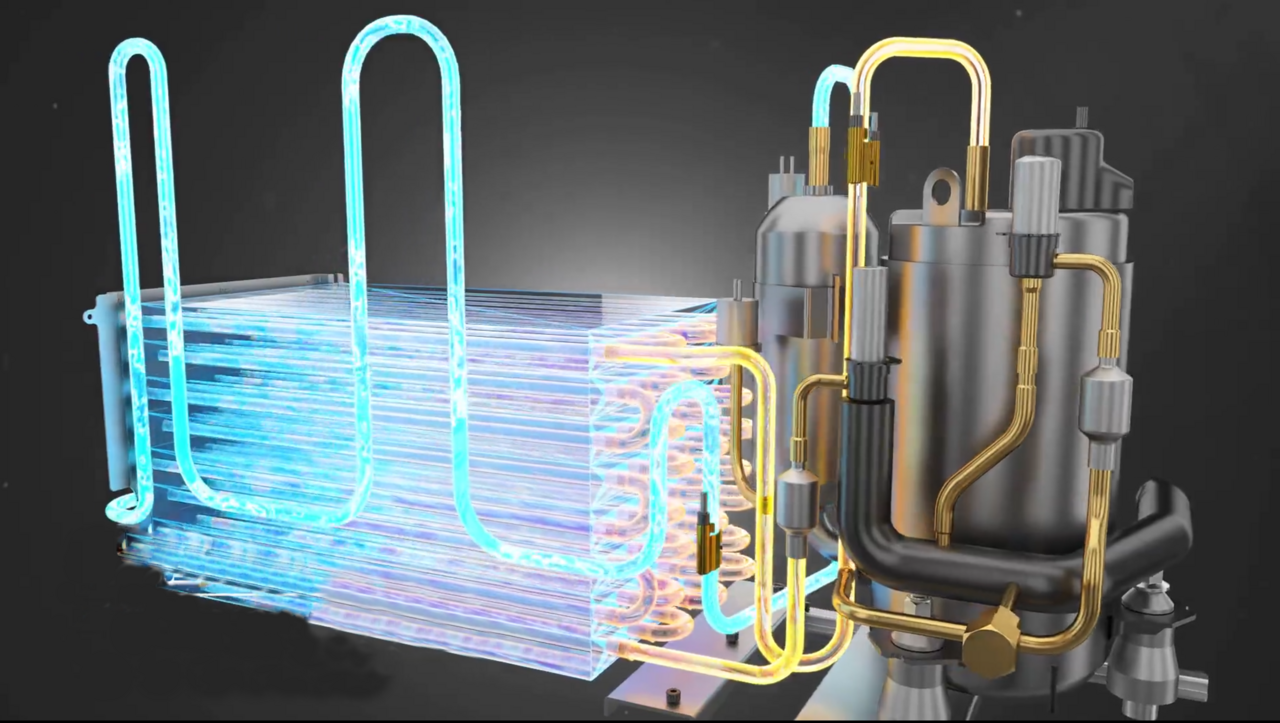
Our High efficient Heat pump with invertor drive reduces drastic the electrical consumption and guarantee a Continuous laser Light Output
Heat pumps are a mature technology that is much more energy efficient than any other cooling or heating technology
We do utilizes our patented cooling technology—the Intelligent double circuit Circulating Constant Temperature System. Automatic sensing and precise temperature control enable effortless continuous welding, even in extreme temperatures and extreme duty load! The high-performance dual circuit condensation cooling device, with an ultra-large fin area and efficient cooling material, continuously dissipates heat, supporting non-stopping high-performance laser light output.
- Refrigeration highly efficient heat pump with inverter drive – No Need for Water
- Unlike air cooling systems, this system operates 24/7 with a 100% duty cycle.
- This is currently the only option available on the market, designed to operate in temperatures ranging from -20°C to +60°C
- It utilizes a double-circuit heat pump, which provides superior cooling efficiency.
Our self-developed efficient high-converting light source brings lower heat generation and a continuous high-energy high brightness laser beam. Self-Cooling Technology: Using an efficient compressor and intelligent refrigerant control, the core components automatically cool, unaffected by external temperature changes.

- Refrigeration highly efficient heat pump with inverter drive – No Need for Water
- Unlike air cooling systems, this system operates 24/7 with a 100% duty cycle.
- This is currently the only option available on the market, designed to operate in temperatures ranging from -20°C to +60°C
- It utilizes a double-circuit heat pump, which provides superior cooling efficiency.
The laser's ultra-stable electronic control solution ensures extremely stable power output and support this stable output with a maximum power fluctuations in the source of less than 1.5%; Even in the event of dramatic environmental changes (such as power fluctuations, temperature changes, etc.), the performance of each machine will always be consistent!

Compared with traditional water-cooled laser welders, this compact laser welding system requires no external chiller, saving equipment space and reducing maintenance costs
With lower power consumption, faster welding speed, and easier operation, it helps manufacturers reduce labor costs, improve production efficiency, and minimize after-sales issues.
Key Advantages:
Traceless laser welding — backside remains smooth and clean
No grinding and polishing after welding
No need to remove protective film before welding
Perfect for stud welding applications
Fast welding speed with stable results
No water chiller required — save space and cost
No winter antifreeze maintenance needed
30~65% lower energy consumption
Compact design, easy operation and transportation
Reduced maintenance and after-sales problems

Inverter-Driven Variable-Speed Cooling
Why does this make a difference?
The basics of the used heat pump are our inverter-driven dual circuit compressors: a drive adjusts the speed of the compressor motor to change with the cooling needs in a home. Also the ventilator inself is adapting its rotation speed with the demand of cooling capacity. A standard air conditioner has a compressor motor that works at only a single speed. The compressor motor is either on or it’s off. With our inverter-driven variable-speed dual circuit compressor, the drive signals the cooling need to the motor of the compressor to change cooling capacity either up or down. This is a continuous process: the drive keeps changing the compressor motor speed to adapt to conditions for a minimal and optimal cooling efficiency.
Why does this make a difference? The compressor motor is the part of an air conditioner that consumes the most electrical energy. For a standard compressor, the motor operates at 100% capacity at all times, and shuts down completely when the thermostat senses the cooling target is met. It then turns back on when cooling is needed once more, but always at the same energy consumption level. But with a variable-speed dual circuit compressor, the compressor motor will often work at lower capacity—40%, 60%, 80%, etc.—to adjust to cooling requirements and switch also regulary from high to low pressure use to reduce the consumption. No need to work always on the highest compression. This not only means much less energy consumption, it means there will be fewer on/off cycles, which is when the compressor draws on the most electrical power. Fewer on/off cycles also means better cooling in your home, with more even distribution because the AC will run for longer periods of time (while using less power) to spread cooling around the laser welder source.
With an inverter driven variabledual circuit speed compressor you only use what you need, thereby saving you money by not consuming energy you don’t need.” The inverter difference: An inverter-driven compressor rarely shuts off, so it is always ready to speed up or down to match heating or cooling demand. It adjusts in increments of 1% or less to exactly match cooling requirement. Cycles are slow, vary slightly as needed and are continuous. This makes them very efficient. And temperatures are very balanced.